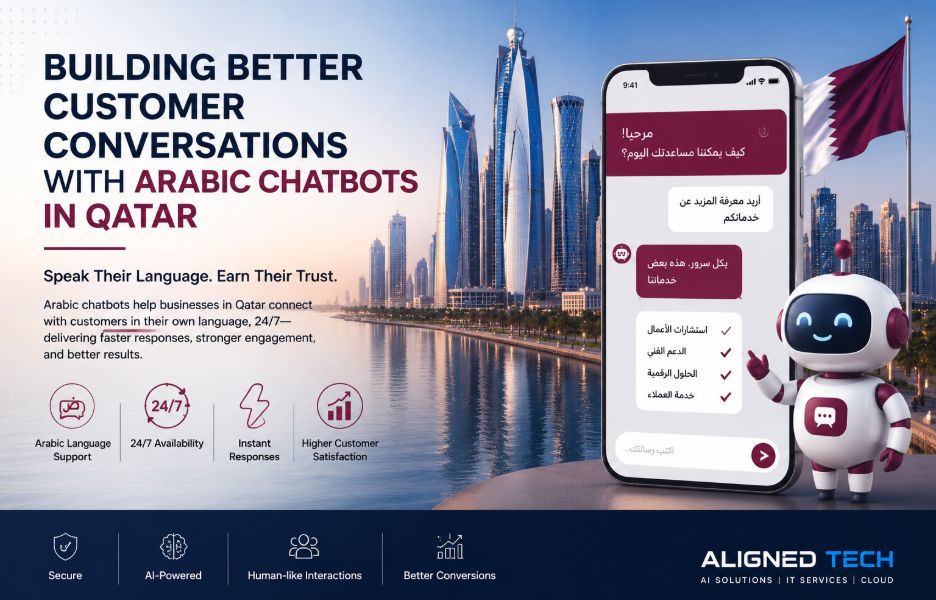
Building Better Customer Conversations With Arabic Chatbots in Qatar

Introduction
Customer expectations have changed dramatically as digital communication becomes part of everyday life. People increasingly expect businesses to respond quickly, provide accurate information, and offer convenient communication channels. For organizations serving Arabic-speaking customers, conversational technology can help deliver these experiences while reducing pressure on customer-service teams.
An Arabic chatbot is more than a digital FAQ. Modern conversational AI can understand natural-language questions, identify customer intent, search approved information, collect details, and transfer conversations to human agents when necessary. When designed correctly, it can become an important part of a company’s customer-service and sales process.
This is particularly relevant in Qatar, where organizations across retail, hospitality, real estate, professional services, education, and other sectors are investing in digital experiences. An Arabic chatbot Qatar business deploys can provide a consistent first point of contact while allowing human teams to focus on complex requests.
Why Arabic Conversational Experiences Matter
Language affects the quality of communication. Customers are more likely to engage naturally when they can communicate in a language they are comfortable using. Arabic support can therefore improve accessibility and make digital services more inclusive.
However, Arabic conversational AI requires more than translating English responses. Businesses should consider regional terminology, sentence structure, common expressions, spelling variations, and the specific vocabulary used in their industry. The system should also know when it does not understand a request and provide a clear path to human assistance.
A strong chatbot should be trained or configured around reliable business information. It should not invent policies, prices, product details, or commitments. Approved knowledge sources, controlled responses, monitoring, and escalation procedures help maintain quality.
Applications Across Qatar
Customer support is one of the most obvious use cases. A chatbot can answer questions about services, locations, operating hours, appointment availability, documentation, and common procedures. It can also collect information before transferring a customer to an employee.
Sales teams can use conversational AI to qualify leads. For example, the chatbot can ask what service a visitor needs, identify the customer’s preferred contact method, collect relevant requirements, and pass a structured summary to the sales team. This can reduce manual data entry and speed up follow-up.
Hospitality businesses can use conversational systems to answer guest questions, provide information about facilities, and support booking-related inquiries. Educational organizations can answer questions about programs and admission procedures. Professional-service firms can use chatbots to collect initial project requirements and direct prospects to the appropriate specialist.
Connecting AI to Business Workflows
A chatbot becomes considerably more valuable when it connects with other systems. Integration with a CRM can allow customer information to move directly into a sales pipeline. Calendar integration can support appointment requests. Ticketing integration can create service cases automatically.
These integrations are part of the broader opportunity represented by AI automation solutions Doha Qatar organizations are exploring. The goal is not simply to create a conversational interface but to automate useful processes behind the conversation.
For example, a customer might ask about a service, provide basic requirements, request an appointment, and receive confirmation without an employee manually entering every piece of information. Complex requests can still be transferred to staff with the conversation history attached.
WhatsApp and Familiar Communication Channels
Messaging applications are important customer communication channels in many markets. Businesses may benefit from extending automation to platforms customers already use, including WhatsApp where appropriate.
A WhatsApp chatbot for business lebanon organizations deploy can help answer common questions, qualify leads, send updates, and support customer-service workflows. The same design principles apply across markets: businesses should define permitted actions, protect customer information, provide human escalation, and ensure that automated messages remain relevant.
The advantage of familiar channels is convenience. Customers do not need to learn a new application or navigate a complicated website. Businesses can meet users where they already communicate while maintaining structured workflows behind the scenes.
Security and Privacy
Conversational systems can handle personal and business information, so security should be designed into the solution from the beginning. Access controls should limit what the chatbot and connected systems can retrieve. Sensitive actions may require authentication or employee approval.
Organizations should also define how conversation records are stored, who can access them, how long they are retained, and how they are protected. Monitoring can help identify unusual activity and quality problems.
Human oversight remains important. A chatbot should not be expected to resolve every issue. Clear escalation rules allow sensitive, complicated, or unusual requests to reach trained employees.
Measuring Success
Organizations should measure chatbot performance using business outcomes rather than conversation volume alone. Useful metrics include response time, resolution rate, human handoff rate, customer satisfaction, qualified leads, appointment completion, and reduction in repetitive support requests.
Regular reviews can identify questions the chatbot frequently fails to answer. These gaps can then be used to improve the knowledge base and conversation design. Continuous improvement is essential because products, services, policies, and customer expectations change over time.
Conclusion
Arabic conversational AI can help Qatar-based organizations create faster and more accessible customer experiences. The strongest implementations combine language capability with reliable knowledge, secure integrations, analytics, and human support.
Whether the objective is customer service, lead generation, appointment management, or internal assistance, businesses should begin with a clearly defined workflow. With the right strategy, an Arabic chatbot can become an effective digital employee that handles routine conversations while allowing human teams to concentrate on more complex and valuable work.